
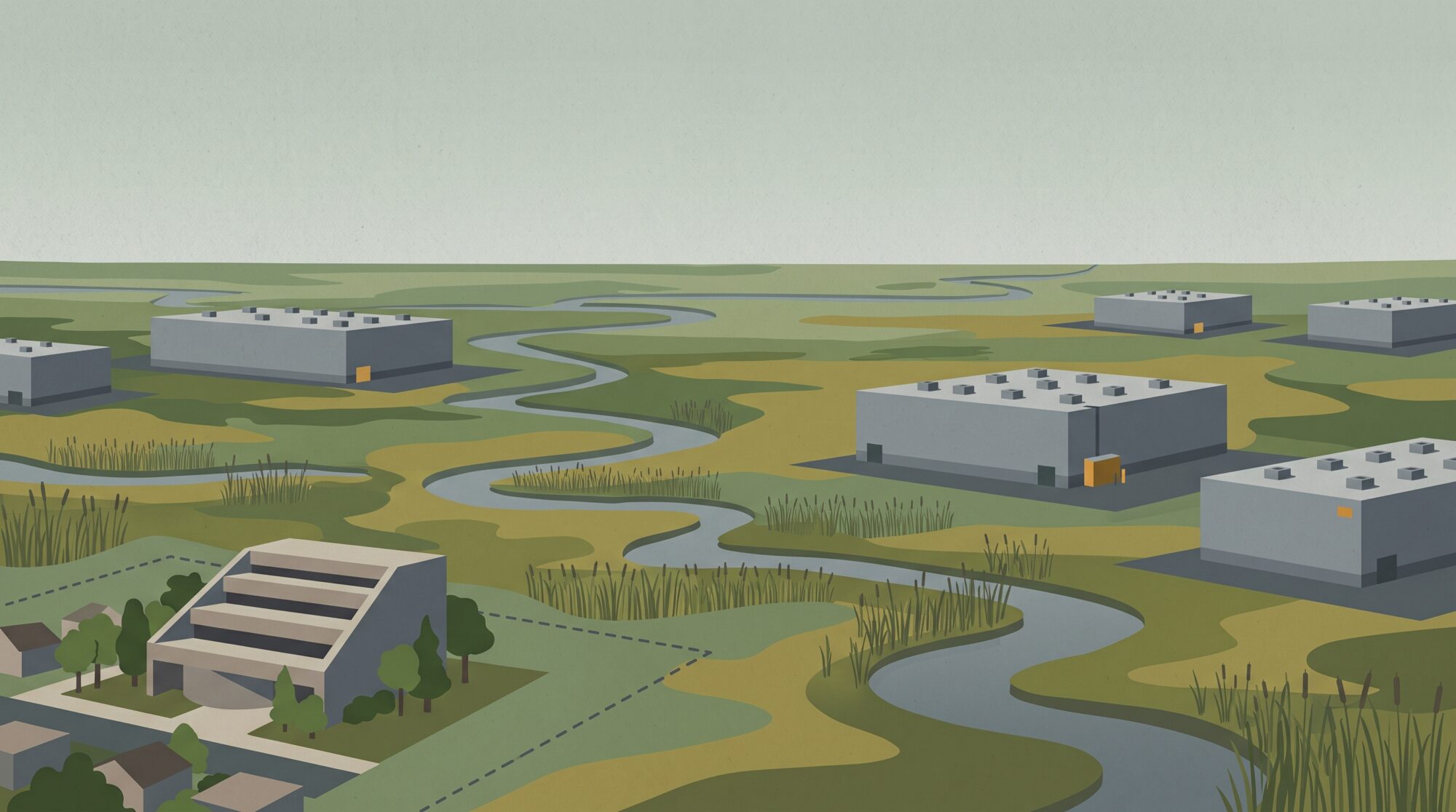
Secaucus is drafting an ordinance to ban AI data centers. According to the town attorney, it would only apply to the small slice of Secaucus the town actually zones. None of the town’s existing data centers sit on that land.
The ordinance, announced at the Oct. 13 Town Council meeting, is the town’s first concrete action since it formed a data center committee in September. It also runs into the same limit Mayor Michael Gonnelli described after the Equinix diesel spill: the New Jersey Sports and Exposition Authority (NJSEA), not the town, controls zoning for roughly 88% of Secaucus.
What the Ban Would (and Wouldn’t) Do
The town attorney said he began drafting the ordinance at the direction of the mayor and council. The target is what officials described as single-operator AI facilities, the kind built for one company such as Google or Amazon Web Services. Secaucus’s current “colocation” data centers, which rent space to hundreds of business tenants, would not be targeted.
Telling the two apart is the hard part, he said. Limits on electrical capacity and water use are under discussion, and the definitions are being written carefully because towns elsewhere in New Jersey that changed their data center rules have been sued by developers.
The ordinance would amend the zoning for the town’s own industrial zones only. Existing data centers would have to comply only if they changed their use or built a new building.
Timeline: The attorney hopes to have the ordinance ready for introduction at the next council meeting. Zoning changes then go to the Planning Board, which has 35 days to review them against the town’s master plan, before a final council vote. He estimated about six weeks in all. Each step requires public notice.
Bob Ceberio, the former executive director of the New Jersey Meadowlands Commission, praised the effort during public comment, calling AI facilities “a totally different animal” from conventional data centers. He was also blunt about the limits.
“In 1969, you lost all control. All land use power. In 88% of your town,” Ceberio told the council. “You have no say.”
Answers, Courtesy of the Data Centers
Before public comment, council members spent about 30 minutes taking turns reading answers to questions residents asked at the Sept. 22 meeting. Most of the answers were written by the data center operators, CoreSite and Equinix.
The reading followed a private meeting held that morning. The mayor said it included representatives from Equinix, CoreSite, PSEG and Veolia, along with three council members and a small number of invited residents. It was not open to the public.
Among the answers:
- Equinix is nearly doubling a Hartz Way site. Its planned “NY10” facility at 275 Hartz Way, the former Burlington Coat Factory, will grow from about 198,000 square feet on two floors to about 370,000 square feet on four. Its cooling plant can support liquid cooling piped directly to computer chips. Equinix said that “does not mean NY10 is being developed as a dedicated AI center.” The project was approved before the “pause” on data centers the mayor announced after the spill.
- On the spill, Equinix said the incident “was not of the size or impact that would generally be considered a catastrophic event,” though it called it serious. According to the town, a state Department of Environmental Protection (DEP) update dated Oct. 7 says the emergency phase is over and a licensed site remediation professional, hired by Equinix, now oversees the cleanup and investigation. The DEP has not said when it will release its final report.
- On noise, the town shared a Hudson Regional Health Commission report. It found no readings above 65 decibels, the residential limit, near the data center sites.
In 1969, you lost all control. All land use power. In 88% of your town.
Bob Ceberio, former executive director, NJ Meadowlands Commission
Some residents said the morning meeting itself was the problem. Resident David Kraatz, a member of the town’s data center committee, said he was told not to raise the oil spill there. Town Administrator Gary M. Jeffas responded that Equinix had made that its one condition for attending: it would not discuss the spill with a competitor, CoreSite, in the room, and would address it separately.
Kathy McFarland, also a committee member, said the mayor had agreed that morning to regular air and noise testing near the data centers. Gonnelli said he had agreed only to noise testing. “That’s not my purview,” he said of air quality.
McFarland also urged the town to use its zoning board to block data center projects that need variances. The town attorney said that would not hold up. When NJSEA zoning already allows a use, rejecting a project’s parking or loading variances because the board dislikes data centers would be “arbitrary and capricious” and likely overturned in court.
Councilman Robert Costantino pushed back on the idea that the council had sided with the companies, saying it would keep answering every question in detail. “If this takes six months, so be it,” he said. Gonnelli said the issue was one of many he handles.
“Data centers is just one little nodule of the amount of work we do,” Gonnelli said. “I come in at 7:30 every morning. I work till four o’clock. I drive around every day. I check everything out. I do a lot of work. If you don’t want me here, so be it.”
Kraatz ended his time at the microphone with an announcement. “I just really feel that the council needs some changing,” he said, and declared a write-in candidacy for Ward 2. Councilman James Clancy, of the mayor’s Moving Secaucus Forward ticket, is otherwise running unopposed for that seat on Nov. 3.
Where the Power Is: Oct. 22
With most data center decisions resting with the state, several speakers pointed to the NJSEA’s next board meeting. It is scheduled for Thursday, Oct. 22 at 10 a.m. at the Meadowlands Environment Center, 2 DeKorte Park Plaza, Lyndhurst. Details on the NJSEA website.
One resident urged residents and officials to attend. Gonnelli said he is trying to get other Meadowlands mayors “on the same page” to push the NJSEA for changes.
Several questions remain open after Tuesday’s meeting:
- The DEP’s final spill report: no release date yet.
- Air quality monitoring: the mayor declined to commit to it.
- Community benefit agreements, a study of the combined impact of all of the town’s data centers, and decommissioning plans: residents submitted these questions in advance. They were read aloud but not answered.
- Equinix’s operational details on the spill: Kraatz’s questions about the pump’s flow rate and staffing during the fuel transfer were sent to Equinix and remain unanswered.
- The ordinance itself: how the town will define an “AI data center,” and whether the NJSEA will be asked to adopt similar rules for the 88% of town it controls.
“Even small data centers create big problems,” one resident told the council.