
Secaucus’s data center ordinance is back, and the fine print has changed. On Tuesday the council introduced a rewritten version of the zoning rules it pulled two weeks ago. The new draft keeps the 80-megawatt power cap but changes how it is measured. It drops a rule that counted neighboring properties together and adds exceptions on cooling, generator testing and reporting.
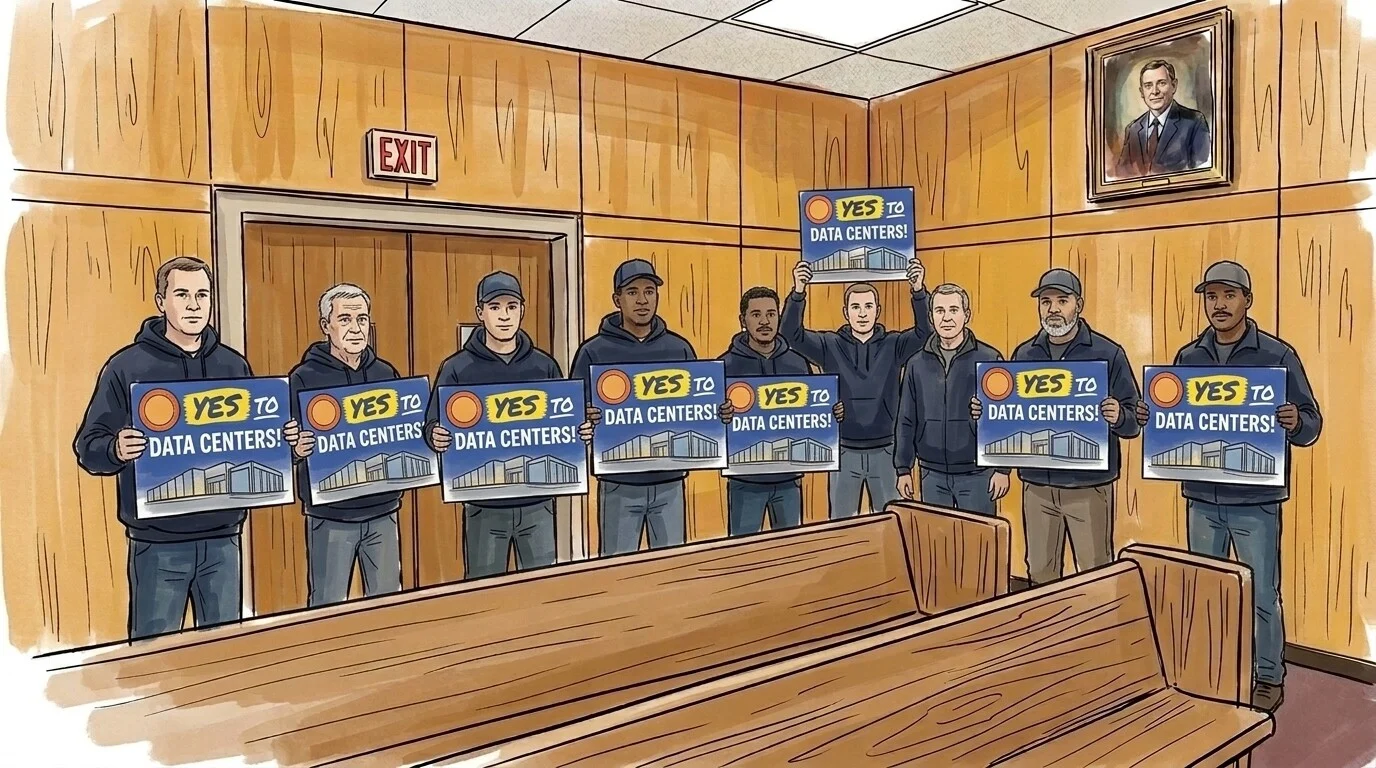
The crowd changed too. At the Oct. 27 meeting, residents filled the room to press the mayor on data centers. On Nov. 10, about 20 members of the electrical workers’ union joined them, many holding signs that read “Yes to Data Centers!” It was the first organized show of support for data centers at a council meeting this fall.
What Changed
The ordinance still only covers the town’s own Industrial Zone, not the roughly 88% of Secaucus zoned by the New Jersey Sports and Exposition Authority (NJSEA). The noise rules and the water supplier’s sign-off stayed the same, but a Scoop comparison of the two drafts found five significant changes:
- The cap is measured differently. The October draft counted all power “supplied from all sources.” The new draft caps “computational load supplied at any single utility meter location,” then says that includes cooling and other non-computing loads.
- Neighboring lots no longer count together. The October draft added up data centers on “contiguous or commonly controlled properties,” or built in phases with shared infrastructure. Now they are added together only when they sit on the same block and lot.
- Cooling exceptions. An existing data center that uses once-through cooling, which is otherwise banned, may connect an expansion to that system. And an alternative to closed-loop cooling now has to save only energy, not water and energy.
- Generator exceptions. The Town Engineer can approve testing outside the weekday 9 a.m. to 3 p.m. window, and “comparably low-emissions fuel” is allowed alongside ultra-low-sulfur diesel.
- Confidential reports. Data centers can meet the town’s annual reporting requirement with copies of reports they file with the state, which the town would keep “confidential.”
At the meeting, the town attorney summarized the ordinance as a cap of “80 megawatts per data center” that would keep hyperscale AI data centers out of the Industrial Zone. He did not mention the dropped rule on neighboring properties. The council introduced the ordinance without discussion and sent it to the Planning Board.
“Yes to Data Centers”
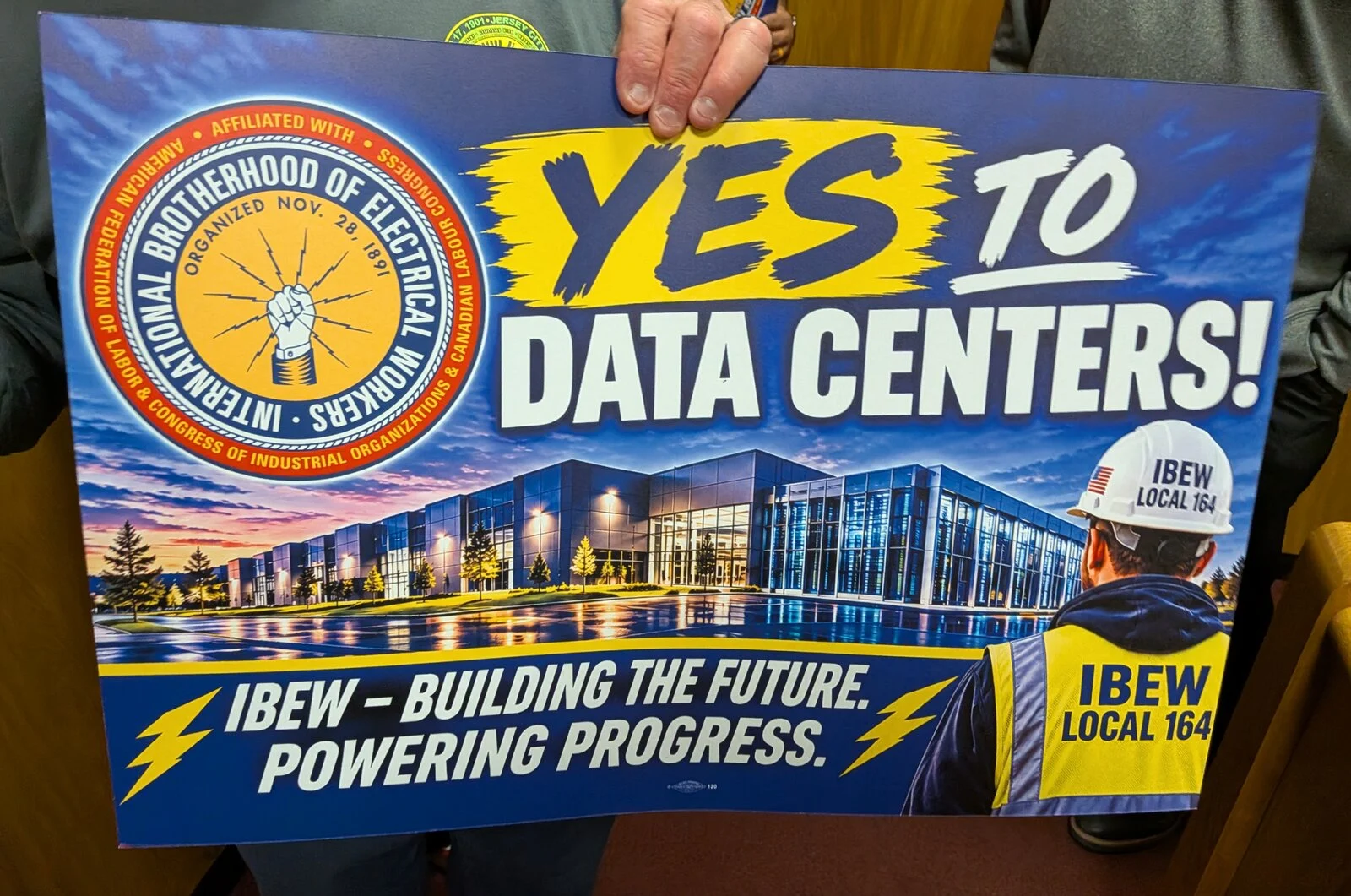
D.J. Heal, a business representative for International Brotherhood of Electrical Workers Local 164 and an officer of the Hudson County Building Trades Council, said union electricians have built Secaucus data centers for more than 25 years.
“That is 25 years of union workers being able to support their families,” he said. He asked the council to “consider each proposed data center on its merits,” and to make sure the town gets a fair return and that infrastructure costs aren’t “unfairly shifted” to residents.
“Lacks a Lot of Teeth”
Residents who have opposed data centers this fall thanked the council for bringing the ordinance back. Then they went through it line by line.
A resident who told the council last month that she was reconsidering raising a family in Secaucus asked for a 25-megawatt cap or a moratorium, a ban on diesel backup generators, firm water limits and real penalties. “As the ordinance stands, it lacks a lot of teeth,” she said. She also offered to help the town press the NJSEA to adopt the rules. “We’re on your team,” she said. “I want to join you in the efforts to get this passed and protect the town and protect the people in it.”
Linda Weber singled out the grandfathered cooling and the confidential reports. “Annual compliance report confidential? You kidding me?” she said.
David Kraatz, who ran as a write-in candidate in last week’s Ward 2 election, called the ordinance “a start” with ambiguous language. He said Equinix wants to keep test results confidential, and asked whether the town, if it receives them, would release them or go along with the company. Mayor Michael Gonnelli said he hadn’t heard about the request.
Kraatz offered the council a letter, which he also shared with the Scoop. It is an unsigned, undated draft from the state Department of Environmental Protection (DEP). The draft says Equinix filed a confidentiality claim on Oct. 26 for information the DEP requested after inspecting its NY2 data center at 275 Hartz Way, the site of the September diesel spill. The DEP rejects the claim, finding “no indication” that disclosure would harm the company’s competitive position. The Scoop could not confirm whether the letter has been sent.
Kathy McFarland responded to Gonnelli’s remarks at the last meeting, when he named her and other critics and said residents “hammer me over stupid reasons.” “We are not hammering the mayor,” she said. “We are hammering the myriad risks of 11-plus data centers in our town in the hope that he hears us.”
Noise Tests Found Nothing
Town Administrator Gary Jeffas said Hudson Regional Health Commission noise tests at the town’s data centers, taken in the daytime on Sept. 30 and at night on Oct. 27, found no readings above the town’s limits.
But the commission told him it tests for the low-frequency hum residents describe only after a violation of standard sound levels, Jeffas said. And under state rules, a violation must be measured at the complaining resident’s property. The town’s tests were all taken at the data centers.
What Comes Next
The Planning Board will review the ordinance before the council holds a public hearing and final vote. The board’s next scheduled meeting is Tuesday, Nov. 17, at 7 p.m. at Town Hall. Its agenda had not been posted as of Wednesday.
Whatever passes will reach only the small share of Secaucus the town zones itself. Gonnelli said he met with the NJSEA on Tuesday, and that the agency, which controls the rest, was “very receptive.” The town plans to send it the ordinance once it passes. Whether the NJSEA adopts similar rules will decide how much of Secaucus they cover.